Showing posts with label Finding Feminine Inspiration. Show all posts

Saturday, December 6, 2008

"Oh! that a dream so sweet, so long enjoy'd. . ."


" . . . should be so sadly, cruelly destroy' d" -- [Yes, that is the title of this painting! Bit, of a mouthful, isn't it!] -- by Sir John Everett Millais. Click here to view full-size image.

I love the costume worn by the girl in this painting. The combination of dainty embroidery and black velvet [I'm assuming it's velvet; it certainly looks like it is!] is exquisite. . . also note how the lacy ruffles at the collar and cuffs help to soften and complete the look. . . a very beautiful outfit!

~~~~~~~~~~~~~~~~~~~~~o0O0o~~~~~~~~~~~~~~~~~~~~~

Current Mood: Cranky 

Saturday, November 22, 2008

'Finding Feminine Inspriration' resuscitated

Click here to view full-size image.

I have decided to revive my series on Finding Feminine Inspiration. I hope you all don't mind. 

I felt in need of a little lace and silk and general prettying up.

In this post I will look at April, from Les Tres Rishes Heures du Duc de Berry.

I have a passion for all things mediaeval - castles, cathedrals, gothic architecture, fair maidens, handsome knights in shining armour riding white horses, etc.. I also enjoy studying the clothing worn by women of this period. Some of the trends in men's clothing during the mediaeval period may seem slightly ridiculous to us today - the tights, the exaggerated sleeves and elongated shoes, and - worst of all - codpieces, although the latter did not come into fashion until the late Middle Ages. The extremities in fashion were not limited to men's clothing, however - enormous sleeve cuffs and elongated footwear were fashionable for women, too. Also, some of the women's headgear of the time was quite - bizarre.

However, there is a certain grace and simplicity in many of the outfits worn by mediaeval women. This is exhibited to some extent in the picture I am highlighting today.

This painting is part of the famous Tres Riches Heures du Duc de Berry - a book of hours, or calendar, created by the Limbourg brothers in the early 15th century. The picture shown here represents the month of April.

If you're wondering what exactly is going on this picture (as I was at first), I'll do my best to explain.

A newly betrothed young couple are exchanging rings while witnesses look on and two maidservants gather flowers from the ground below - though unfortunately these flowers are very difficult to see, though I am told they do exist. Perhaps they are invisible flowers. . .

The betrothed pair were real people - the painting is supposed to represent the pledge of troth between Charles d'Orleans and Bonne of d'Armagnac, granddaughter of the same Duke of Berry who commissioned this book of hours. The castle in the background is the Chateau de Dourdon,which belonged to the Duke of Berry.

It is a beautiful picture - the glowing colours, the impossibly blue sky, the greenness of the grass, the overall aura of springtime  and young love - though I must say, the bride-to-be does not seem to look overly enamoured with her future husband, although he certainly appears to be very pleased with himself and his bride. Perhaps she is only hiding behind a discreet veil of feminine modesty and decorum, as  was proper for mediaeval maidens!

I love the outfits worn by all four women in this painting - the high waists and simple lines of the gowns are quite lovely. One gets the feeling that these garments would have given the wearer a delicious sense of luxury, as well as the comfort of the generous and expansive folds of fabric.

I especially like the gown worn by the young betrothed woman - the combination of blue, gold, and white is exquisite. I am not expert enough to know whether the pattern on her dress has been embroidered on or has simply been woven as a part of the fabric itself - either way, it looks lovely!


Current Mood:  Good.

Wednesday, October 1, 2008

On Holidays

We have a couple of birthdays in the family over the next week, and to celebrate, we're having the weekend with my grandparents at the beach! We're all staying at their house in a little village on the coast - it's my second favourite place in the world, besides home.

Now, over the coming days, one of two scenarios will no doubt unfold: either (a) I will be too busy enjoying myself to post anything on here, and you won't hear from me for some time or (b) I will spend a lot of time relaxing fiddling around with my new laptop, and will write many lengthy posts during our brief holiday.

Well, we'll just have to wait and see how things go!

I've decided to give my series on Feminine Inspiration a break for now. I'll still write about art, but it will be within a different context. In fact, I haven't written so much about my favourite paintings as I may otherwise have done lately, because you've already been getting a weekly dose of "Finding Feminine Inspiration", and I haven't wanted to bore you with too many paintings! I may revive F.F.I. sometime - again, we'll just have to wait and see what happens. 

Many Blessings, 

The Editrix

Wednesday, September 24, 2008

Finding Feminine Inspiration Part VII


Woman in a Black Hat (portrait of Irma Brunner), by Manet
This pastel is a stunning symphony of colours. The pink-apricot of the young lady’s dress, her black hat, her white complexion, and her scarlet lips.They all blend together so well. The whole picture seems to convey a sense of class and elegance.

Tuesday, September 16, 2008

Finding Feminine Inspiration Part VI


The Balcony, by Manet
This is an extraordinary painting, one of Manet's masterpieces, but it's usually singled for commentary because the painterly genius and psychological messages expressed within it, not because of the beautiful dresses worn by the two ladies! Nonetheless. . .
The dress worn by Berthe Morisot (sitting at left) in this painting is simply gorgeous. I especially like the sleeves...
The wedding dress of my dreams, while not an exact replica of this dress, would certainly bear several similarities to it.

Tuesday, September 9, 2008

Finding Feminine Inspiration Part V


Anne Hyde, Duchess of York, by Sir Peter Lely

I’m looking at a black-and-white reproduction of this painting. It’s a beautiful dress... if only I knew what colour it was. (Ten minutes later) - I’ve just looked at it on the internet, and it’s GOLD! Ugh! Too much gold in a painting is rather overpowering. But I still like the overall design of the dress. I’d have it in a much more demure (you could say boring) colour. But then again... that gold is growing on me. If I were a duchess, sitting to have my portrait painted by one of the most renowned portraitists in England, I probably would wear something dazzlingly fabulous - fabulously dazzling. But gold isn’t for everyday wear. Another thing - gold paint was very expensive, so if your portrait had a lot of gold in it, it would have been something of a status symbol.

Tuesday, September 2, 2008

Finding Feminine Inspiration Part IV


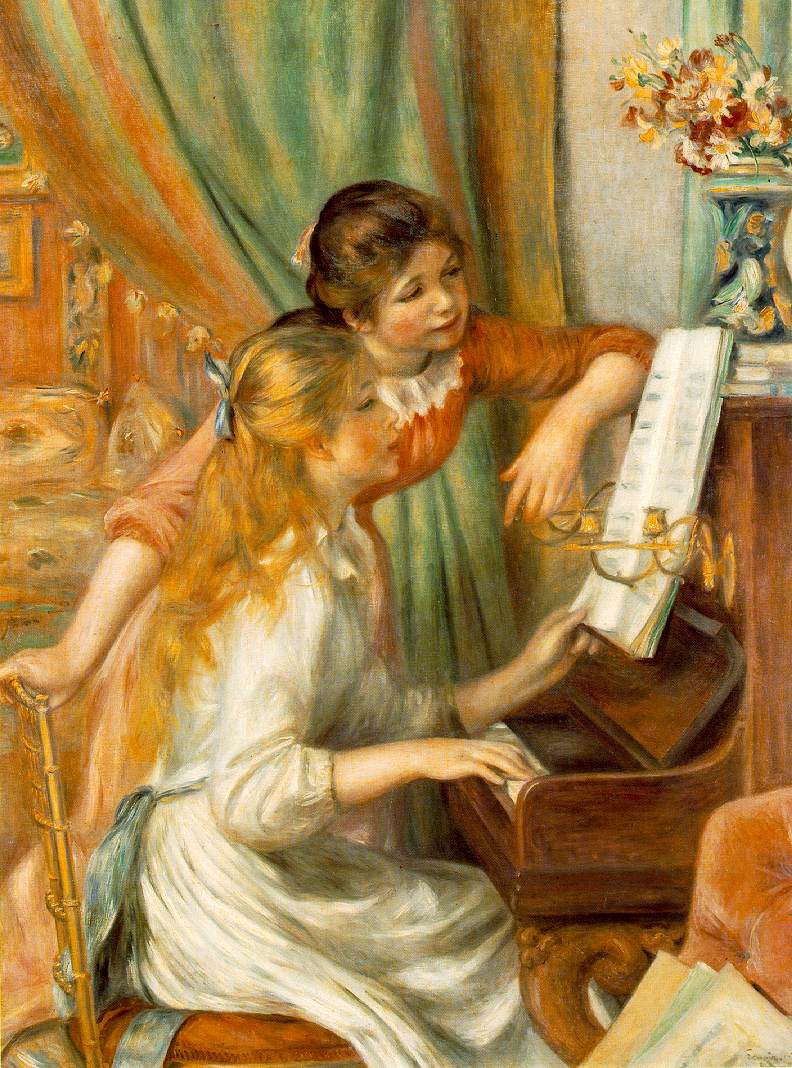
Young Girls at the Piano, by Renoir
This is perhaps one of Renoir’s best known paintings, and it’s not hard to see why. There’s something so sweet and eternally appealing in this picture of two girls, with their long hair and lovely dresses.
I love those dresses! The lace, the bows, the three-quarter length sleeves - so simple but so beautiful.

Tuesday, August 26, 2008

Finding feminine inspiration part III


Portrait of Anne Bruce, Mrs. Bruce of Arnot, by Allan Ramsay.
This is a lovely portrait. The look is elegant, yet soft and pretty. Simple, but not overly-simplistic. The pearls, the roses, and that beautiful lace! Mrs. Arnot’s hair, too, is simply yet attractively done.

Tuesday, August 19, 2008

Finding Feminine Inspiration Part II


The Arnolfini Marriage, by Jan van Eyck
Some clothes love you, others don’t. The latter pinch and squeeze and endeavour to make you feel as uncomfortable as possible. But clothes that do like you fit perfectly and seem to envelop you in a warm embrace. One gets the feeling that the dress worn by the soon-to-be-wed Giovanna Cenami in this famous double portrait would be warm and comfortable, as well as feminine and flattering. A delight to wear, just as this painting is a delight to look at! I’m not quite sure about the vivid blue underdress; but those small splashes of blue do contribute to the overall visual effect of the painting, which is no doubt why van Eyck painted them. Three of my favourite colours - red, green and blue - are beautifully combined in this masterpiece.

Tuesday, August 12, 2008

Finding feminine inspiration in the art of eras past

Today's clothes and fashions for women are often very un-feminine. It's a trend that appears to have started in the 1920s, when androgynous clothing was all the rage, and then things got even worse in the 1960s...

Anyway, the point is, we've almost forgotten what it means to be female - to be a lady. True femininity starts inside - it's a heart issue, really. BUT, I guarantee you'll find it easier to think and act like a lady, like a daughter of the King, if you dress in beautiful, feminine clothes! Clothes do make a difference in the way we behave and in the way others treat us.

So, I've decided to start a new series of posts. Because it's become so difficult to find truly lovely clothes in the world of fashion today, we need to look to the past for inspiration. In each post I'm going look at a classic painting, and scribble down some of the things that I particularly admired in the design of the outfits worn by the lady/ladies in each picture. Most of what I write probably won't be very remarkable - but the idea is for you to look at each painting and make a mental note of the things that most struck you about it.

Two of my favourite things combined - art and beautiful clothes! Today's post is about one of Titian's masterpieces. . .

Portrait of a Noblewoman (or La Bella) by Titian

I love the golden embroidery on the rich blue fabric - it’s a wonderful effect; very luxurious, but at the same time not over the top. That particular shade of blue interspersed with darker stripes... and it’s complemented beautifully by the ruddy brown colour of the sleeves.

* * *

To read more articles on this subject, click here then click on the link 'Feminine Dress' in the sidebar on the left.